Atienza glossary
The words proper to Atienza: arrebatacapas, prioste, seises, Atienza Romanesque, mighty crag… The definitions that give context to the village.
1. Group
The village and its urbanism
- Arrebatacapas
- Gothic arch of the Atienza wall, on the Plaza del Trigo. Due to its narrowness, the wind would snatch (arrebatar) the cloaks (capas) of muleteers entering the village.
- Peña muy fuerte
- Expression from the Song of the Cid (12th c.) describing the fortified crag of Atienza. The quote justifies Atienza being a key milestone on the Way of El Cid.
- Cerro Padrastro
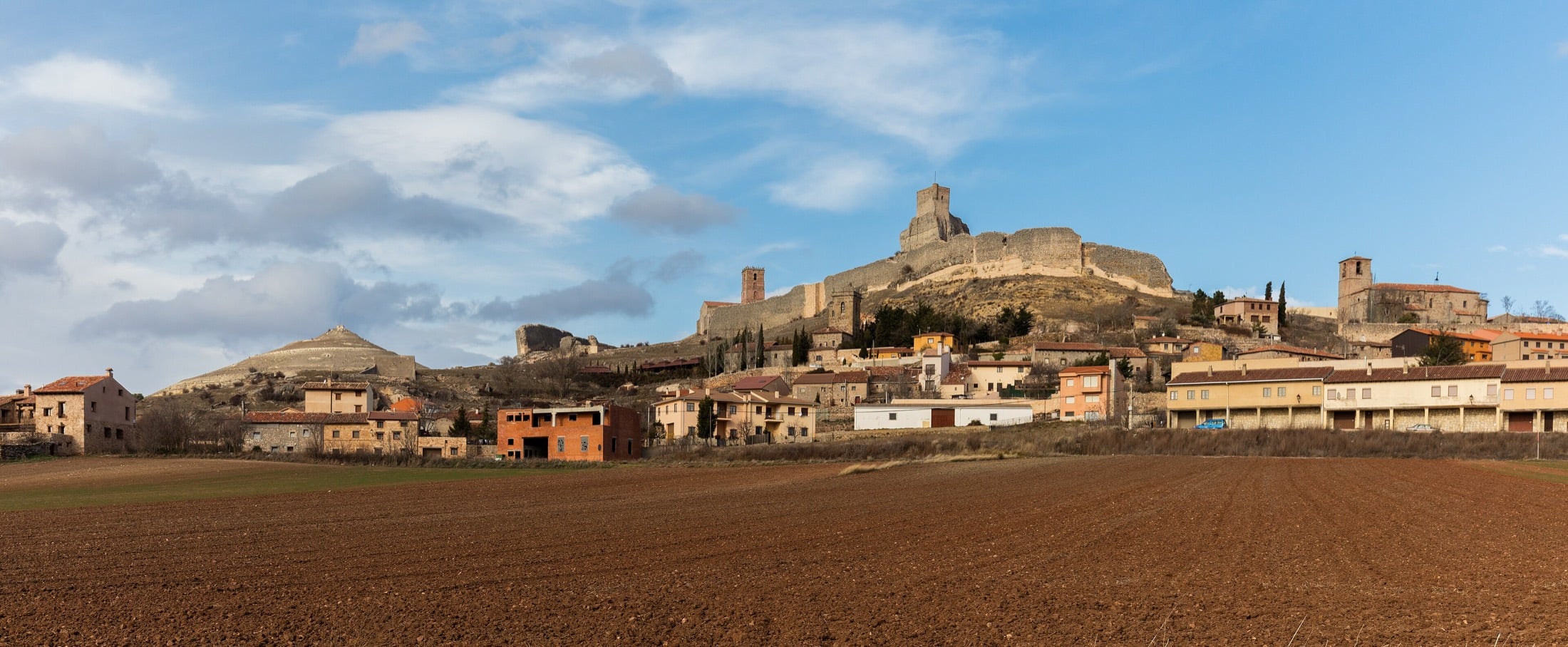
- Hill south of Atienza from which the most complete panoramic view of the village and castle is obtained.
- Plaza del Trigo
- Also called Plaza del Mercado. Medieval heart of the walled old town of Atienza, with stone-column porches.
- Conjunto Histórico-Artístico
- Legal protection figure for Spanish heritage. Atienza was declared a Historic-Artistic Site in 1961.
2. Group
La Caballada and the Brotherhood
- La Caballada
- Festival declared of National Tourist Interest (Spanish government designation given to traditional festivals of outstanding cultural value), celebrated every Pentecost Sunday. It commemorates the 1162 ride that saved the boy king Alfonso VIII.
- Cofradía de la Santísima Trinidad
- Brotherhood founded after the flight of Alfonso VIII to perpetuate the memory of the muleteers. Preserves documentation since 1679.
- Prioste
- The most visible role of the Brotherhood: keeps the banner in his own home throughout the year. Rotates by lottery.
- Seises
- The six brothers who accompany the Prioste during La Caballada, dressed in traditional black jackets and hats. The name comes from «seis» (six in Spanish), their founding number.
- Arrieros
- Medieval transporters with mules. The Atienza muleteers devised in 1162 the stratagem that saved the boy king.
- Sábado de las Siete Tortillas
- Eve of La Caballada: brothers gather in the Plaza del Trigo for a traditional meal.
3. Group
Architecture and art
- Románico atencino
- Rural school of Castilian Romanesque developed in Atienza between the 12th and 13th centuries.
- Arquivolta
- Set of concentric arches that decorate the portal of a Romanesque church. The one at Our Lady of Val (1138) has ten figures.
- Torre del homenaje
- Main tower of a castle, lord's residence and last defensive stronghold. The one at Atienza survives on the crag.
- Soportales
- Covered exterior porches characteristic of medieval Castilian urbanism. The Plaza del Trigo of Atienza is a notable example.
- Sillería
- Wall built with ashlars (carved stone blocks). Distinctive of Atienza Romanesque churches.
4. Group
Landscape, routes and UNESCO
- Paisaje Dulce y Salado
- Cultural landscape candidate to UNESCO World Heritage, shaped by the fresh water of rivers and the salt of historic salt pans between Sigüenza and Atienza.
- Camino del Cid
- Cultural tourist route following the itinerary of the Song of the Cid. Atienza is the end of the «Exile» route and the start of «Frontier Lands».
- Ruta de la Lana
- Variant of the Way of St. James that crosses Atienza between the Sigüenza – Atienza and Atienza – Retortillo de Soria stages.
- Salvoconducto
- Official booklet stamped at each stop on the Way of El Cid. In Atienza it is stamped at the Town Hall or the Tourism Office.
- Romería
- Popular pilgrimage to a hermitage. The one of the Virgin of the Star is the literary origin of La Caballada.
- Sierra Norte de Guadalajara
- Region in the north of the province of Guadalajara where Atienza is located, at 1,169 metres of altitude.
5. Group
Gastronomy and tradition
- Gallina en pepitoria
- Castilian stew of chicken with almonds, saffron, hard-boiled egg and white wine. One of the emblematic dishes of Atienza cuisine.
- Migas del pastor
- Shepherd's dish based on stale fried bread with garlic, paprika and pancetta. Served with grapes or melon.
- Rosquillas de la abuela
- Traditional Atienza sweet made with oil and anise. Classic dessert of the family recipe book.
- Torrijas
- Easter sweet: a slice of stale bread soaked in milk and honey, fried and coated in sugar.
- Bartolillos
- Typical Atienza sweet: small sweet fried dumplings filled with pastry cream.
- Leche frita
- Set milk cream with cinnamon and lemon, coated in egg and flour, fried and dusted with sugar.
6. Group
Historical figures
- Alfonso VIII de Castilla
- King of Castile (1158-1214). His escape from Atienza as a child in 1162 is the origin of La Caballada.
- Rodrigo Díaz de Vivar (El Cid)
- 11th-century Castilian knight whose feats inspire the Song of the Cid. Atienza appears twice in the poem as a «mighty crag».
- Álvaro de Luna
- Constable of Castile and favourite of John II. In 1446 his troops took Atienza, causing partial depopulation of the village.
- Juan Martín «El Empecinado»
- Guerrilla leader of the Spanish War of Independence (1808-1814). Operated near Atienza against Napoleon's troops.
- Catalina de Lancaster
- Queen consort of Castile (1390-1406) and mother of John II. Atienza was part of her seigniory.
- Salvador Carmona
- 18th-century Castilian sculptor, author of the Christ of Forgiveness kept in the Holy Trinity Museum of Atienza.
7. Group
History and administration
- Titrhya
- Pre-Roman name of the Atienza crag, already occupied by the Arevaci. Appears in some classical sources.
- Fuero de Atienza (1149)
- Charter organising the village after the Christian Reconquista, granting privileges to favour its repopulation.
- Sexmas
- Medieval administrative divisions of the Community of Atienza, grouping villages dependent on the town.
- Comunidad de Villa y Tierra de Atienza
- Medieval council encompassing the village and its surrounding territory with administrative, military and economic functions.
- Guerras de los Infantes de Aragón
- 15th-century conflict between John II of Castile and his Infante cousins. After these wars, Atienza's demographic recovery was cut short.
- Conquista cristiana de Atienza
- Took place at the end of the 11th century after several campaigns. The Arab castle was reused by Christians.
8. Group
Nature and geology
- Gneis
- Metamorphic rock that forms the crag on which the Atienza castle stands. It determined the strategic choice of the site.
- Río Salado
- Tributary of the Henares river that names the «Salt Landscape» of the UNESCO candidacy. Its historic salt pans witness medieval salt trade.
- Sierra de Pela
- Mountain massif north of Atienza, natural border between the northern and southern plateaus of the Iberian Peninsula.
- Paramera
- High and arid plain characteristic of the Atienza landscape, with scattered oaks and cereal fields.
- Sabina
- Slow-growing tree typical of the Atienza area. The pillars of the Estrella hermitage porch are of sabina.
Keep discovering Atienza
Editorial articles, heritage entries and the calendar complete the glossary.